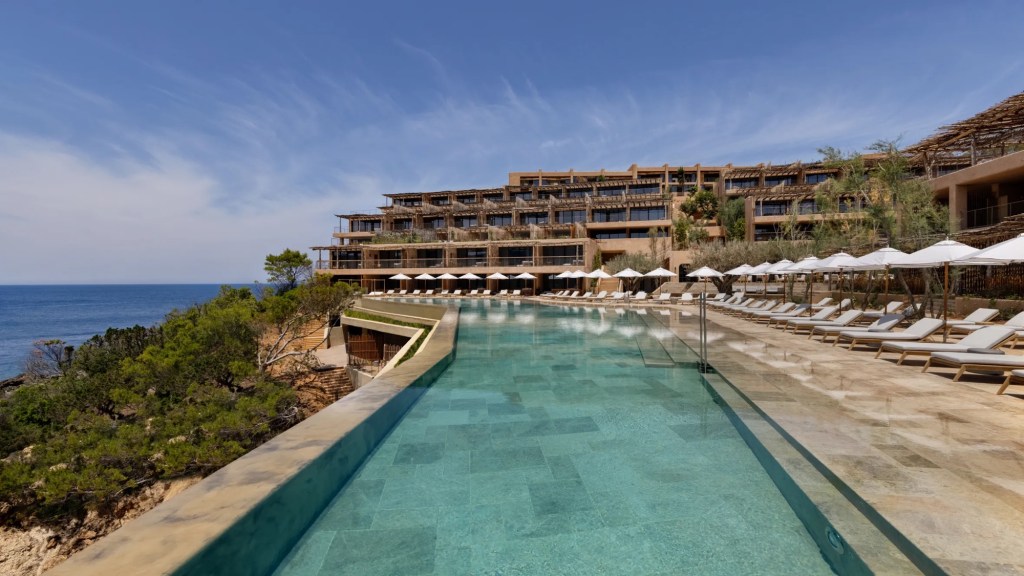
If you watched the re-run of the BBC’s Life Beyond the Lobby featuring Six Senses Ibiza this week, you weren’t just watching a luxury hotel. You were watching the story of Ibiza.
Not the Ibiza of £1 breakfasts, Club 18-30 reps and inflatable lilos. The new Ibiza.
What struck me wasn’t the celebrity guests, the wellness gurus or the eye-watering villas. It was the location itself. A generation ago, this was a perfectly decent family hotel. Parents queued for the buffet while the kids disappeared into the pool. It was the sort of place thousands of British families happily returned to every summer.
Today, on exactly the same piece of coastline, stands one of the Leading Hotels of the World. Think about that for a moment. In the space of one generation, Ibiza hasn’t just upgraded its hotels, it has completely reinvented itself.
The island no longer competes with Benidorm, Magaluf or even Tenerife. Today, it’s competing with Miami, Dubai, Mykonos, St Barths and the Maldives. By any measure, that’s an extraordinary transformation.
The irony is that many people still talk about Ibiza as though nothing has changed. They complain that toast and avocado costs too much or that hotel rooms are expensive, as if the island is somehow still aiming for the bargain holiday market. It isn’t.
Whether we like it or not (and plenty don’t) the market has moved. For the past twenty-five years, Ibiza has been climbing relentlessly up the tourism ladder.
Five-star hotels have replaced three-star accommodation. Beach clubs have replaced beach bars. Michelin stars have replaced fish and chips. Wellness has become every bit as important as nightlife.
Family enclaves such as Portinatx and Cala Llonga now boast stunning hotels catering to a discerning adults-only clientele. Luxury isn’t an accident, it’s a business model but there’s another side to the story. There always is.
The BBC showed beautiful suites, holistic treatments and impeccable service. It didn’t show hospitality workers commuting from the mainland because they can’t afford to live here. It didn’t show teachers struggling to find somewhere to rent, or young Ibicencos wondering whether they’ll ever be able to buy a home on the island where they grew up.
That’s the contradiction.
The same transformation that has made Ibiza one of the world’s most desirable destinations has also made it one of Europe’s most expensive places to live. Success has come with a price tag.
The debate shouldn’t be whether Ibiza has changed. That argument is over. The BBC programme simply confirmed what anyone who has lived here has watched unfold over the past three decades.
The real question is whether the island can continue chasing luxury without losing the character that made people fall in love with Ibiza in the first place because once authenticity disappears, it rarely comes back.
The old Ibiza isn’t coming back, the new Ibiza is already here. The only question is whether we’re shaping its future, or simply standing back and watching it happen.

 MAN IN SAN AN by Martin Makepeace
great article as always x
LikeLike