
Space Ibiza has it’s San Antonio Hotel Licence Rejected…For Now 

San Antonio Town Hall has rejected Space Ibiza’s request for a license to its newly acquired hotel because issues with several ‘shortcomings’ said the Deputy Mayor Juanjo Ferrer who is charge of the towns Planning Department. Among the deficiencies detected was the intention of having outdoor music however the project has already been revised, amended and is on the table again to be rereviewed by technicians.

The project was presented to San Antonio town hall in July 2015 and is based on reforming an existing hotel, raising it to 4 stars, adding extra rooms whilst also incorporating a nightclub with ample parking.

Space founder Pepe Rosello is one of San Antonio’s favourite sons and has long expressed his desire to bring the Space Ibiza brand to the town of his birth. He’s not a man to take no for an answer so don’t be surprised if this story takes on plenty of twists and turns.

Source: Nou Diari


Ghetto Heaven: San Antonio v Magaluf – by Joan Lluis Ferrer

Joan Lluis Ferrer is an award winning author and journalist at the Ibiza daily newspaper, the ‘Diario de Ibiza’. He is one of San Antonio’s most vocal critics and his polarising commentary on Ibiza’s 2nd largest town is always interesting if not always entirely correct.
He wrote the award winning book “Ibiza: The Destruction of Paradise” and has now followed it up with his new title  called “Journey to Trash Tourism” detailing what he believes is wrong about certain elements of tourism in some of Spain’s most popular resorts. 

Here he talks candidly with his own newspaper about his book and what he discovered during his research. Translated in it entirety he makes some valid points but does Sr Ferrer understand the British psyche? What do you think?

Diario de Ibiza: What is ‘Trash Tourism’ as referred to by the title?

Joan Lluis Ferrer: I define it as the type of tourism that is not only crowded but their habits are completely incompatible with the collective well-being but also constitutes a danger to the economy itself. It is tourism characterised by alcohol and drug abuse, revelry without control. It’s dangerous to those who practice it because of certain dangers such as a balcony fall or an overdose. The other key feature is causing problems of coexistence wherever it is and in its most advanced stage it causes the residents to leave their own town.


DI: The Book is divided into 4 areas of the Mediterranean: Lloret de Mar (and Salou), Barcelona, San Antonio and Magaluf. Why these 4 places?

JLF: These are 4 areas ranging from less to more conflict. The 1st grade is Lloret and Salou, where ‘Trash Tourism’ is confined to a fairly specific geographical area and the rest of the people have a fairly normal pace of life. Then we went to the old town of Barcelona, with the Raval, Barceloneta and Gothic quarter, which is in an advanced stage because there is not only a tourism binge but is causing many residents to leave their homes for the inconvenience it causes, entire neighbourhoods. The 3rd phase is the West End of San Antonio. The process of flight of the resident population is much more advanced as is the process of replacing traditional stores for fast food joints and club ticket outlets. San Antonio is replacing the resident local population with those of immigrants who can put up with lower prices and that lifestyle. Then there is the upper stage, which is Magaluf. Magaluf is the capital of ‘Trash Tourism’ in Spain. It differs from San Antonio as there are very few residents there and the predominance is drunken tourism. In San Antonio there is some vestige of normal life, Magaluf is a theme park of alcohol.

DI: Are these phases progressive? San Antonio in is in phase 3, will it soon be in phase 4?

JLF: That’s the conclusion I have drawn. If San Antonio remains the same then within 10 years it will be a Magaluf. In the absence of measures those who have taken control are the business people in the industry of drunkenness, which incidentally are no longer local entrepreneurs but above all British.  In all these places; Barcelona, San Antonio or Magaluf there is a landing mass of entrepreneurs, especially British, who specialise in binge tourism. If you are looking for pub crawls there are internet companies advertising with photos and videos with drunk people on the ground, vomiting between containers … and their customers are no more than 18 to 25 years old.


DI: Are these youngsters searching for this type of holiday or do they find it?

JLF: There are two types of cases: Firstly the case of those who go looking for it , those who want a holiday to get drunk and fall on the floor. Then there are many cases where a kid falls from a balcony purely because they had the bad luck of going to San Antonio or Magaluf. They were the kids that their parents paid for their trip to Spain after finishing their studies. The parents know it is a group tour and think they will be fine. They have no idea where they are going. They know that there are beaches, nightclubs and fun but they could not suspect the degree of non-control. Many of these kids who go to the pub crawls know they are going to drink but they are not hard-core drunks or people who take drugs. In the book there is a teacher who says that many of these people who kill themselves don’t even get drunk in their country of origin. Yes, they go out with friends, yes they have 2 or 3 three drinks but they aren’t inveterate drunks.


DI: So they neither drink or take drugs to the extreme in another environment?

JLF: Nor in any other circumstances. They do it here purely because they are here. If you are in a group of people that take you to get drunk then what do you do? You get drunk, stagger back to the hotel, the balcony door is open, you fall and you kill yourself. If we profile many of these kids who are killed falling off the balcony we can see that they had brilliant academic notes and exemplary records, healthy people who had the bad luck to fall here.


DI: So you say ‘Pub Crawls’ seem to ‘induce’ or cause these deaths. A responsibility nobody assumes?

JLF: What you have to understand is that the bars that rely on young drunken tourism, and there are many in the West End and Magaluf, are endangering the lives of many young people and not only that but they are killing many of these young people every summer. Every year in Ibiza 5 or 6 kids die from falling off a balcony. Between Mallorca and Ibiza 32 young people have died ‘balconing’ from 2010 to 2013. It is an inducement to get drunk and kill themselves. Everyone is free to drink alcohol and take drugs, what we cannot have is an establishment that induces it in such a savage way through websites that should be banned.


DI: Pub crawls are permitted by law?

JLF: They’re banned but as with so many other things everyone seems to turn a blind eye. Local laws forbid them but in real life everything is permitted. In San Antonio there are laws to cover everything but almost nobody complies.  The pub crawl is an activity prohibited in most Spanish tourist towns but it still goes on.  Instead of banning it some places such as Magaluf allow it with regulation where there has to be monitors, a maximum number of attendees but I’ve seen with my own eyes that the regulations weren’t fulfilled. Many of these activities are banned but tolerated and there is a total permissiveness.

DI: Do you think that this situation is reversible?

JLF: What is amazing is the power of this industry to establish themselves and challenge the rules that exist.  They are a power to which public institutions are totally ineffective. In San Antonio we are tired of seeing it. They pass through the limits of any mandatory law. Public administrations are those that have to act decisively but the hundreds of complaints that are received every summer are against prostitution, drug trafficking, closing times that are not met and noise.  In the end the sanctions are negligible, they open a file but it ends up in the trash.


DI: Why is this happening?

JLF: It’s a mystery. I attribute it to institutional apathy, although politicians in question tell you they have no means to deal with the avalanche of complaints. What I cannot understand is that there are means to process the flood of planning permissions with which is urbanizing Ibiza by leaps and bounds and requires processing yet there are no means to force these ‘Binge Bars’ to close and these bars are destroying our image and putting the lives of young people at risk. There is a saying that “you can’t do everything” which is what encourages this to continue. There have been a few strong sanctions, recently San Antonio Town Hall dealt with a bar due to excessive noises but they may order a closure but we see that nothing has closed. There is a dereliction of duties, they have the skills but no will. We’ve been 40 years with this scourge that is the West End.


DI: The West End is 40 years old?

JLF: Yes, yes, it’s stagnant there. Ibiza goes ‘Luxury and High End’ and we have San Antonio which in summer is a madhouse outdoors. And in winter it is an abandoned place.


DI: How was the experience of visiting these places?

JLF: It was born from a personal curiosity because in the end journalism is that, a curiousity about how things are. I wanted to know how far the West End had gone, more or less of a disaster than Magaluf, more or less than Lloret, understand it’s place so I went to these sites to see. I already wish that San Antonio was more like Lloret de Mar. There in the Avenue of nightclubs are patrol cars of the ‘Mossos d’Esquadra’ (similar to Guardia Civil) while the local police patrol every street in the area on foot and the rest of the town is immaculate. It will be a miracle the day we see this in San Antonio. In Salou the problem you have is with the ‘Saloufest’, which is total chaos but is limited to a time and a specific space. In Barcelona, you go to Barceloneta and other neighbourhoods and people are scared. They leave because they cannot stand the noise of groups that party until 6am. A neighbour told me that he was vomited on from a balcony above and when he complained they broke his window in retaliation. It is a real problem when tourist and residential accommodation are side by side.


DI: Well here the Government wants to legalise private apartments for holiday lets?

JLF: Biel Barcelo (Balearic Minister of Tourism) should take a walk through Barceloneta, the Gothic Quarter and Raval to see what is happening and then try to live in one of those apartments.


DI: And then you visited Magaluf?

JLF: That far exceeds San Antonio because it’s like a Disneyworld dedicated to drunks. In San Antonio there are many off licences with their bottles inside but in Magaluf they have them on the sidewalk in enormous pallets directly offloaded from cargo ships.  Up to 10 pallets of alcohol on the sidewalk, so big you can’t get past. Souvenir shops sell alcohol, tobacco shops are part toabcco part off licence at the same time … I do not know, it’s an amazing thing. All this oriented towards drink. Try to look for the residential part of Magaluf and it doesn’t seem to exist. There are some buildings where residents live but I really don’t know how they can live there?


DI: So you’ve seen everything?

JLF: It makes the hair stand up on your neck with the thought of your child going there.  We’ve all run riot in life but … that excess and the general induction to get drunk and get high, that’s another thing. In Magaluf I remember seeing a mother with a stroller with a baby dodging drunks at two in the morning at Punta Ballena next to a terrace with a load of messed up fortysomethings dancing on tables, these are scenes from another world.

Source: Diario de Ibiza

Original article in Spanish

BEWARE: Villa Scammers Operating in this Area


Scammers are continuing to cause havoc to some peoples plans by promising sumptuous villas that don’t exist.

With the demand for Ibiza villas hitting an all time high, con artists are preying on unsuspecting tourists by copying villa details from genuine websites then passing them off as their own.

They then ask for a payment to be sent by bank transfer promising to meet the clients on arrival in Ibiza but once they get the money they disconnect their phones and the website gets taken down.

The problem has reached such a point that many villa websites such as HomeAway and Owners Direct have changed their business model to compete with Airbnb so that funds are only released to villa owners and operators once clients have arrived and are happy in their chosen villa.

So what can you do to counter these pirates? Firstly do a little online research. Has the company got a Facebook page that is active and has genuine commentary? Does it have a Twitter or Instagram account that is active? Have you googled the name of the person you are talking to? Are you speaking to an office or a foreign voice at the end of a random mobile phone?

If the deal looks too good to be true then it usually is. Don’t send any money to obscure bank accounts that can’t be traced. Only send money once you are entirely satisfied that you are talking to a genuine villa operator and there are plenty of good ones out there. 
If in doubt then don’t do anything until you are happy. If possible speak to friends who have dealt with villa operators in Ibiza and get a direct referral.

In this social media cyber world you can usually spot the scammers a mile away by their posture and don’t hesitate to challenge them.

HomeAway, Owners Direct, Holiday Lettings and AirBnB now offer to ring fence your money so take advantage of this service. Alternatively use an established Ibiza Villa Operator that is accountable.

It isn’t rocket science but can also be a potential minefield if you don’t do your homework. The good news is that if you do follow some of these guidelines you can get unbelievable deals on some amazing villa. 

Related: Telegraph – Tips for avoiding holiday villa fraud

Cathy Guetta’s Lavish Ibiza House Party – No Expense Spared

Just when you thought that Ibiza couldn’t get any more nouveau riche Cathy Guetta has proved otherwise by throwing a huge house warming party for her new multi million euro villa inviting 800 friends and acquaintances to party with her. 

The ex-wife of DJ and French producer David Guetta, who received a monster divorce settlement just 18 months after renewing their vows, officially opened her new Ibiza pad ironically called ‘Villa Titanium’ which is considered by Forbes Magazine to be one of the most exclusive on the island and one of the 11 most expensive villas in the world. 

The sumptuous abode is located at Km 5 on the Sant Josep road and was designed by her very own hand. It boasts 12 bedrooms all with en-suite bathrooms, a round the clock staff of 24, a nightclub called the Cathy Cat Club, four shops for yoga, meditation and massage, a spa and a 3-hectare garden.  The house can be rented at the very”reasonable” price of 251,000 euros per week for up to 24 people.

The party was considered by many to be the most glamorous of the Ibiza season so far, not skimping on any details for the invited guestlist which included many well known celebrities.

Black Coffee, a renowned South African DJ, was in charge of the music while lavish food and drink was served. Decor included living statues and chocolate fountains…….enough said. 

David and Cathy renew their vows – August 2012
Source: Nou Diari

Pirates Taxis to the Left, Illegal Street Sellers to the Right 

In ugly footage Telecinco’s ‘El Programa del Verano’ yesterday ran an undercover report and exposed on Spanish national TV Ibiza’s wide scale pirate taxi problems that occur daily on the island.

An undercover reporter exposed in less than 5 minutes what most of us have known for many years: large organised gangs of illegal drivers offering overpriced journeys with the optional add on’s of drugs and prostitution.

In a 12 minute special the TV programme laid bare the problem and lack of action taken by the authorities in confronting these illegal drivers. The reporter questioned the drivers themselves and also tourists showing that these drivers usually charge double even for small journies.

Ibiza Pirate Taxis – Undercover Report

While the pirate ‘taxi’ drivers ply their illicit trade unhindered at the airport and large clubs San Antonio’s seafront has also been in the spotlight after local residents prepared to make a formal complaint about a group of 6-8 women of African origin that gather daily between the egg and the Hotel Arenal.


Their  ‘trick’ is to pretend to shake hands with passersby then quickly put a small fabric bracelet on their wrists. Unsuspecting tourists are then asked to pay for it in a threatening manner with most just handing over the money to avoid confrontation.

One local resident issued a plea on Facebook when her husband saw a young boy appear to have a seizure when being harassed by the group whilst others have complained about young children being targeted.

It will be interesting to see how Ibiza’s lawmakers respond to these incidents and whether they will continue to hide behind the usual excuse of Spanish national law and it’s limitations whilst changing local laws to fine establishments for a whole range of minor infractions.

Ibiza is generally a very safe place however visiting tourists should be aware of these local issues. Always use a licensed taxi even if you have to wait a few extra minutes and if an African lady on the seafront tries to put something on your wrist then a firm and polite NO usually suffices.

If they continue to not take NO for an answer then threatening to call the local police will definitely do the trick. Please remember that if you agree to be bullied into paying for something you didn’t ask for and didn’t want then you become part of the problem, not the solution.

Residents v Tourists: San An’s Biggest Battle

San Antonio
Whilst on the school run recently an inebriated tourist fell over in front my car in a fit of giggles. Then later in the same afternoon an almost identical thing happened.  Coincidence? I don’t believe in coincidences.

I couldn’t help sneering at the tourist then instantly regretted my reaction feeling that I’d ‘let the side down’. Tourism is San Antonio’s lifeblood but there in that moment I was wearing my residents cap. I’ve worked in tourism for over 25 years and understand the dynamic so if I felt like this just imagine how some local residents must feel when they see these antics on an almost daily basis.

This is now the biggest challenge for San Antonio, namely getting the balance right between residents needs and tourist requirements to ensure that San Antonio continues to be a busy, vibrant and attractive tourist destination but also a safe and clean place to live. 

Since the change of Mayor in 2015 San Antonio council has mainly sided with residents stating a desire to change the touristic model and putting residents needs above those of tourists. This could be viewed as a high risk strategy as without tourism what do we have? 2016 will be the busiest summer on record for Ibiza but the reality is that Spain is succeeding by default with other destinations off the map however all it takes is one thing to see a seismic shift in fortunes.

Back in the 80s & 90s Ibiza was a very different animal. Very busy in the summer but very quiet in the winter when migrant workers left the Island looking for work. Fast forward to 2016 and Ibiza has doubled in population to 200,000 all year round, there’s a housing ‘crisis’ and an unwillingness to compromise in the summer months that the Island always had before.

To change the touristic model you need the infrastructure and investment and without that you are in effect asking tourists to ‘change’ their ways.  It goes without saying that some San An tourists aren’t the best behaved but with little police presence on the streets it’s not hard to see why.

So now the big challenge for San Antonio is trying to keep everyone ‘happy’ but when you have tourists (young and old), families, kids, residents, businesses, villas, bars, clubs, hotels and schools all living side by side then it’s inevitable that someone is going to have to compromise. The question is: Can we afford for it to be the tourists all the time?

Facebook post from angry resident

Annoying Summer Visitors – The Rulebook

One of the beauties of living on a holiday island is that you can invite friends and family to come and stay. Surprisingly they can never make it out of season so here is self confessed grumpy old man Frank Leavers’ Rulebook for all those annoying summer visitors, especially the ones that ‘can only come to see you’ in the first 2 weeks of August.

Rule 1) You are getting a FREE holiday, if you want a lift to and from the airport, book a flight that arrives/leaves at a reasonable time. 

Rule 2) I am not God, the weather is nothing to do with me. 

Rule 3) If you lay in the sun you will burn; if you don’t wear a bikini top someone will stare at your t*ts, get over it! 

Rule 4) There is no such thing as a self-replenishing fridge – the occasional pack-of-beers, bottle of wine and bag of prawns will be most appreciated. 

Rule 5) I am not a taxi service, if you intend to explore the island great stuff, well done – rent a car, even if it’s only for a day. 

Rule 6) Switch off the bloody air-con in your room when you are not in it; have you seen the electricity dial thingy spin like buggery when the air-con is on? 

Rule 7) NEVER say “what are WE doing today” as you will be physically removed from the premises.

Rule 8) I have never been to a SuperClub in my life and do not intend starting now.

Rule 9) If you insist on having ‘drinks’ at a frontline bar do not, repeat do not, complain to me that you were charged 15 euros for a gin and tonic – I really don’t care. 

Rule 10) If you have enjoyed your holiday and your FREE stay with friends, why not take them out and treat them to dinner? Not a pizza parlour, nor a take-away Chinese joint, but a proper restaurant with linen tablecloths and waiters with long aprons and crisp white shirts; go on, you know you can do it.

Frank Leavers is a journalist, cricket aficionado and all round nice bloke. He can be heard weekdays on Radio One Mallorca. 

Amnesia Investigation

An investigation into the tax affairs of Ibiza super club Amnesia has resulted in the arrests of 4 people including the owner, his son plus their lawyer and accountant. 

The premises near San Rafael was raided on Tuesday morning (5/7/16) by Guardia Civil officers and Spanish tax authorities who spent 17 hours searching the clubs offices, removing dozens of boxes of documents before finally allowing the club to reopen on Tuesday evening and only after Amnesia argued that the investigation didn’t include a suspension of business activities.

Sources close to the investigation have revealed that at least 2 million euros in cash was found after the 7am raid which was shrouded in secrecy and employed agents from Mallorca and Madrid to contain any possible leaks and also included searches of bank deposit boxes, homes in Barcelona and Ibiza and a boat. 

The investigation, supervised by Judge Maria Luisa Bustillo, was initiated following a complaint lodged last October suggesting that’s Amnesia’s owners have evaded the payment of significant amounts of corporate tax and IVA (VAT) for several years. In 2011 Amnesia declared income of 13 million euros with 18000 euros profit. 

Despite the intervention the club has continued to operate as usual issuing a statement later on Tuesday saying “Finally….we can OPEN TODAY”. 

Source: Diario de Ibiza

New Free Car Parking for San Antonio

As the island experiences more traffic congestion than ever before San Antonio Town Hall has been proactive in opening a large new parking area for the town on the Ses Variades waste ground adjacent to the sea and the sunset strip.

They have struck a deal with the owners, the Matutes group, to use the land durning the summer season. It’s accessible via the an entrance/exit opposite the petrol station at Calo des Moro. 

It’s excellent news for drivers especially those wanting to experience the sunset as the car park is less than 2 mins from the bars that make up the world famous sunset strip.

In addition the council has also relaid the car park on Calle Macabich/Calle Madrid next to Cervantes school making the surface more durable and putting in clear space markings to avoid the usual chaotic anything goes parking 

San Antonio’s West End: “The Situation is Unsustainable”

pic: Daniel Espinosa
Pep Colomar, the President of San Antonio’s West End Association has spent half his life working in one the town’s and Ibiza’s most famous and busiest streets, firstly helping with the family business then taking the reins of the popular Bar Colon.

Now 37 years old, he has witnessed the evolution of San Antonio and remembers a different West End: “For years Germans, Dutch, Scandinavians came … it was very different from now.” Colomar is convinced that the return to that type tourism is possible, “it only takes the will of the people and the town hall to enforce the law”.

Here in an interview with Ibiza daily paper El Periodico he gives his views on the summer season so far.

Q: As we come into the peak season, from your experience, how do you think it’s going?

A: The Season is more or less like last year. This year started earlier and we had a pretty good May and June like last year but unfortunately we still have the same problems as every year: PR’s, illegal street sellers, prostitution, crime and theft.

Q: Last year the change of government occurred during the season but I understand that there are things that haven’t changed?

A: This winter, like every year, we talked with the Town Hall to plan the season. The Illegal PR situation had become a problem, each bar and club were allowed to have a specific number of legal PR’s in certain areas but unfortunately the old rules weren’t followed and the news rules have just aggravated the problem.

Q: How come?

A: The old rules weren’t followed and the numbers were exceeded. The Town Hall said it was difficult to distinguish legal PR’s from illegal PR’s (even though the legal ones wore reflective vests) and said it was difficult to enforce the law. On this basis the Town Hall decided to completely ban ‘dynamic publicity’.  We agreed as long as it was enforced. Now can see that it isn’t being enforced and the unfair competition is brutal. Those who fail to comply with the law have grown and become strong and it has been a huge disadvantage for those who do not have people outside their bars trying to attract customers inside.  Many are falling into despair and desperation because no correct measures are taken or being enforced.

Q: What does the Town Hall say?

A: We have talked with them 3 times since May and their consistent answer is that they are acting to enforce the law but they aren’t doing enough. This failure is causing us many difficulties and problems within the West End Association. There are people who are already saying that they can’t follow the law because their neighbours are ignoring it and they are suffering, it’s a very serious problem. They feel helpless because their neighbours have PR’s, loud music, open doors yet are calm because nothing happens, no police and no formal complaints.

Q: The problem lies in the failure to enforce the law?

A: Yes. If you have a law then you must enforce it. The laws have been passed but it is very difficult to monitor compliance if there are no police officers. We need more police in all areas and is absurd to not have enough. If there are no police on the street it is useless to have a law that penalises bars, the Town Hall should prioritise and tackle the most serious problems first. We have asked that if they can’t enforce the law then at least they should allow dynamic publicity again. Last year we hired private security guards but were told they weren’t allowed to do the work of the police so we asked the Town Hall, as an emergency measure, to let them accompany police officers but they said no.

Q: Is it increasingly urgent to change the San Antonio tourism model?

A: Yes, it’s urgent. The process needs to start so we can fix the things that are wrong. That’s not to say I just want nice families to come to San Antonio and nothing else because you can’t change overnight. If there are still these problems of public order, drugs, prostitution, crime then the model cannot change. First you have to fix all that and then the model will change automatically. It’s absurd to go to a trade fair to sell a San Antonio that does not exist. We must fix the problems first and them the model will change.

Q: How do you make the change?

A: The model change should be encouraged by both sides. The Town Hall enforcing the rules and entrepreneurs working differently, offering a higher quality product. The problem is that if the Town Hall doesn’t do enough then there are many bar owners who out of greed or whatever will continue to work illegally because it’s easier and more profitable but this shouldnt be the case. We are complementary offer. For us, if there is a change in the tourism model them it should be relatively simple to adapt to our business. This year there are 4 bars fully reformed in Calle Santa Agnès. But again, the priority is to end the unfair competition. It all starts with the rules. If you make laws then don’t enforce them you create 2 problems.

Q: So the ball is back in the Town Hall’s court?

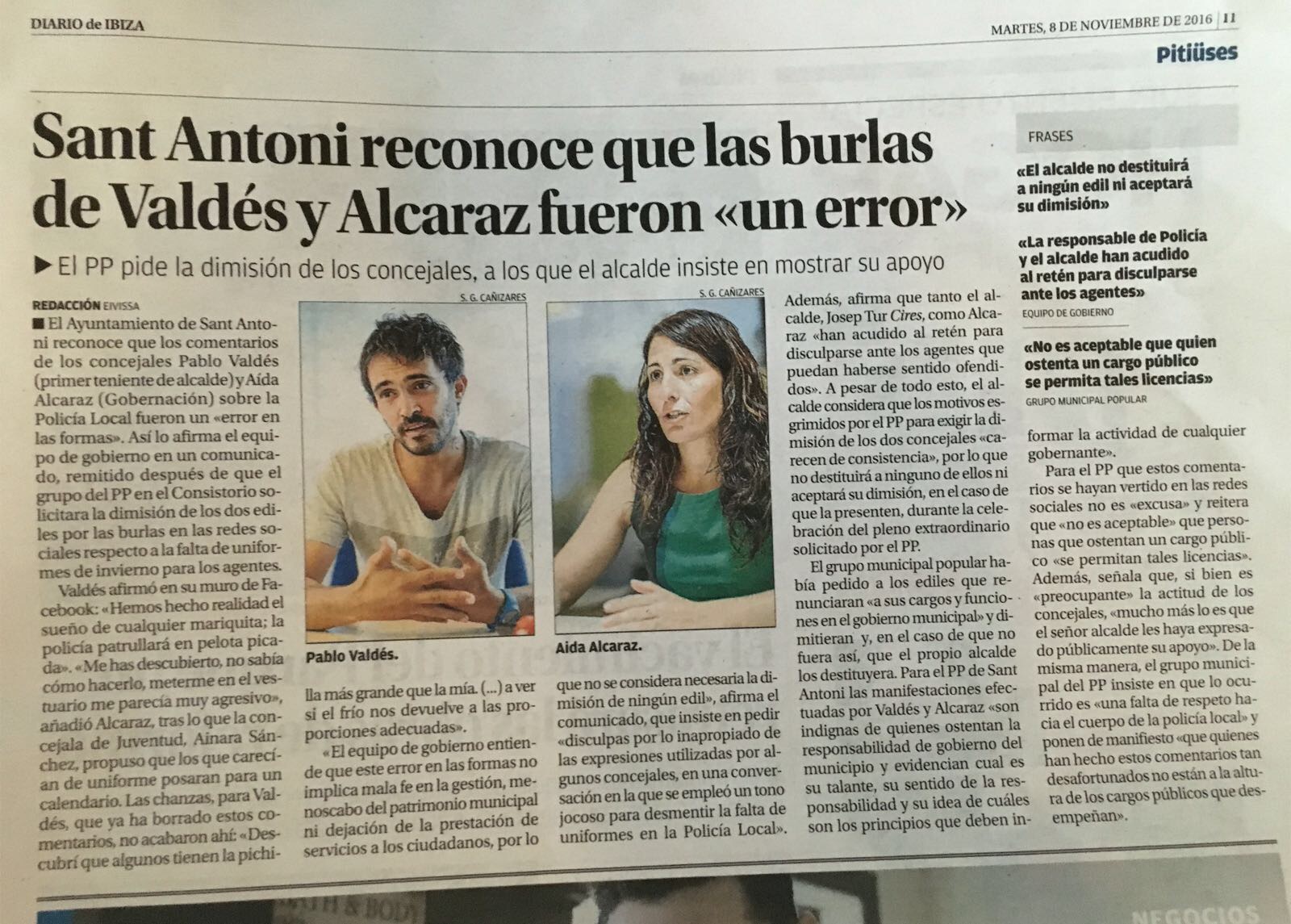
A: Aida Alcaraz (Councillor for the Interior) tells us that they are making policing arrangements, but the reality is that the same problems are still here. It’s not enough and the situation has got worse. There is good dialogue with the Town Hall but this in itself is not enough, specific actions are required. I understand that we demand a lot but this is because they do little. Always they argue that their hands are tied by the law but as entrepreneurs we must demand certain things as we pay taxes and they have created rules that have not been met and have in fact had a perverse effect. If you create rules and can’t enforce them then that is making the situation worse as well as committing an injustice. They must be realistic about the strength of the local police, they say there are more agents than ever in San Antonio but the reality is that there are clearly insufficient. In addition agents do jobs that aren’t theirs, they are overwhelmed.

Q: Despite all these obstacles, it is possible to change San Antonio?

A: I think so. Everyone in San Antonio wants better and if everyone pushes in the same direction then the model change is possible. We agree with the rules but when you do not know how to enforce the remedy then it becomes worse than the disease. We understand that the police are overwhelmed but employers also also overwhelmed with a sense of desperation that the rules are not being enforced and some people do exactly what they want. They say complaints for non-compliance will be processed faster but nothing has changed. The situation has reached a point that is unsustainable and changing the tourism model is urgent.

Source: El Periodico

Original interview: in Spanish